AURORA Workshops
  • ABOUT
    • THE TEAM
  • Workshops
    • WORKSHOP DETAILS
    • GROUP BOOKINGS
  • UPCOMING EVENTS
    • ISL SYLLABUS
  • Blog
  • Contact
  • AURORA Newsletter

BLOG

​What is practice?

1/25/2021

0 Comments

 
what_is_practice.mp3
File Size: 1740 kb
File Type: mp3
Download File

Picture
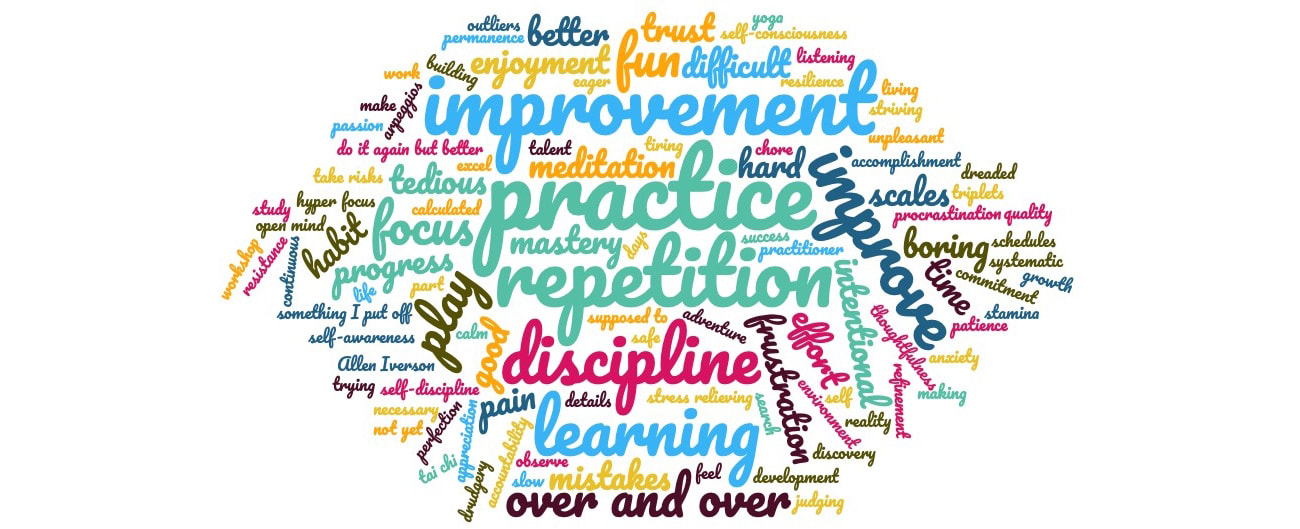
What words arise in your mind when you think about the word “practice”? Depending on your experience, the ideas and emotions tied to it could vary widely.

All new skills require practice and entail a period of doing things badly before they can be done well. In some cases, you may find joy in the practice, even if you’re not as good as you’d like to be. Perhaps you learned how to catch a ball with a parent, and it was fun even when you kept fumbling.

Other times, the repetition and failed attempts may be tedious and frustrating. Learning to touch type typically involves repeating the same 2 to 4 keystrokes hundreds of times, which translates into a lot of time typing reams of gobbledygook. This is rarely fun for anyone, unless the practice can be turned into a game. 

It may help to know what is actually happening inside your brain when you practice.

When you begin to learn a new skill, you have to concentrate hard and consciously think about what you’re doing. It takes a lot of energy! With repetition, your brain starts to build neural pathways — physical connections between neurons, formed to facilitate that specific skill. The more you repeat the action, the more connections grow, and the stronger that neural pathway becomes. The stronger the neural pathway becomes, the easier it is to perform that skill. With enough repetition, the skill can seem almost effortless.

This physical aspect of learning is true whether the new skill is a physical one (like riding a bike or playing an instrument) or a cognitive one (like playing chess or doing mental math). 

Knowing that there is a physical component to learning a new skill can reduce the frustration of making mistakes. No one starts lifting weights and expects they’ll instantly become stronger. We know that it takes time and repetition to strengthen our muscles. Physically building your brain is no different. When a new skill feels difficult, remind yourself that you are physically growing new connections in your brain, and that the process of growing neural pathways takes time.
Audio read and recorded by Fawn Fritzen.
0 Comments

The Pomodoro Technique

4/3/2020

0 Comments

 
the_pomodoro_technique.mp3
File Size: 1613 kb
File Type: mp3
Download File

Picture
​The Pomodoro Technique can help lessen distractibility and keep you on-task.

Here's how you do it:
  1. Choose a task to be accomplished.
  2. Set a timer for 25 minutes. 
  3. Work on the task until the timer rings. You've completed one pomodoro!
  4. Take a 5-minute break.
  5. After you've completed 4 pomodoros, take a longer break (25 minutes).

​Why does this work?
  • The Pomodoro Technique combats distractibility by combining goal-setting with a time limit. When you know you have a finite period to complete a task, it's easier to focus.

Picture
FAWN'S BONUS TIP: I've also found this technique helpful for mitigating the effects of hyperfocus. "But Fawn!" you say. "Why would I want to break my concentration when I'm 'in the zone' on a task?"

Well, maybe you don't. But there are certain computer tasks that I can easily do for 3-4 hours without a break. Sitting in a chair for that long is terrible for my body and my brain. (Remember, physical activity is important for your brain!)

I've found that if I honour the 5-minute breaks by getting up from my chair to do some stretching and refill my water glass, I can finish the task feeling refreshed, rather than exhausted and stiff. That means I have the energy to do another task afterward.

Adjust the pomodoros and break times to suit you. For teens, whose brains are not yet mature, I may recommend 15- or 20-minute work periods. Sometimes, I'm so eager to get back to a task that I can manage only a 2-3 minute break. That's still better than none. Make the Pomodoro Technique work for you!

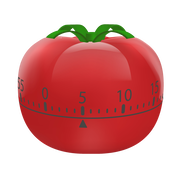
(Why is it called the Pomodoro Technique? "Pomodoro" is Italian for "tomato". When the technique was first developed by Francesco Cirillo, he used a timer shaped like a tomato!)

0 Comments

A Smarter To-Do List

3/27/2020

0 Comments

 
a_smarter_to_do_list.mp3
File Size: 1953 kb
File Type: mp3
Download File

Picture
Thirty percent of your cerebral cortex is dedicated to visual processing. What does that mean? It means that adding visuals to blocks of writing helps your brain understand better.
​
Enter: Time Circles


​


​

​
This simple and powerful idea is taken from Marydee Sklar's "Seeing My Time" course. Here's how it works:
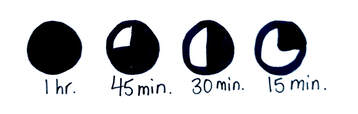
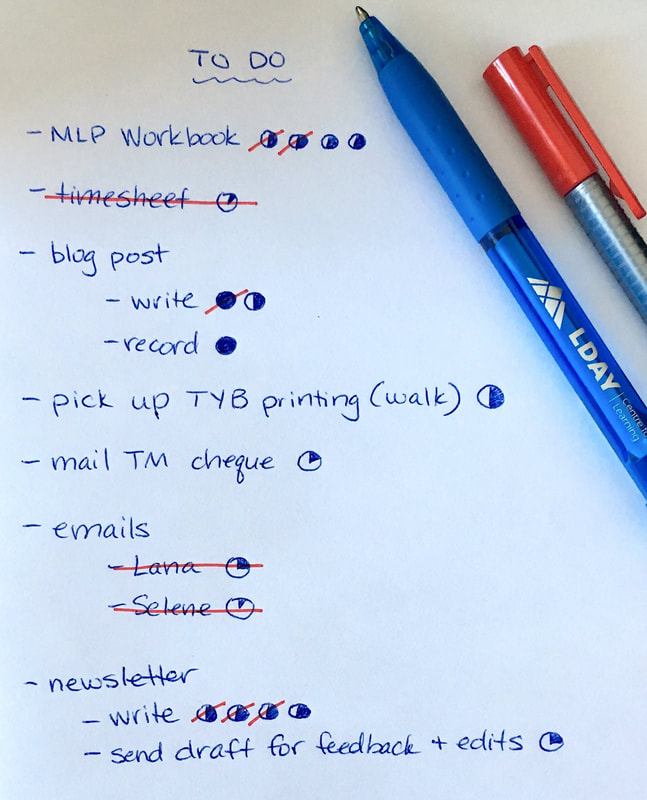
  • Next to each item on today's to-do list, draw a circle and colour in the amount of time you think the task will take. A full circle is one hour. A half circle is 30 minutes. You can even fill in a tiny segment for a 5-minute task.
  • If one task will take days, break it up in to smaller chunks so you can focus on what you need to get done today.
  • If a task will take several hours, draw a series of half-hour chunks. For example, a 2-hour task can be represented by 4 half-hour time circles. After each half hour of work, you can cross off one of your half-hour circles.

​Why does this work?
  • Your brain loves to make predictions. Estimating the time primes your brain to work. (Plus if your prediction is way off, you can plan better for the task next time.)
  • Take advantage of dopamine. Don't you love that feeling of crossing something off your list? That's your brain releasing dopamine! Breaking large tasks into smaller ones lets you give your brain a hit of dopamine every time you complete a chunk of work. That, in turn, can help you to stay focussed.
  • Knock off small tasks. Sometimes you'll find yourself with an empty few minutes in your day. With a visual list, you can spot the 5-10–minute tasks and get them done in the unexpected gaps. These tasks can also get done when you're in a low-energy period of your day.

Here's a sample to-do list:

Picture
​Audio read and recorded by Fawn Fritzen.

0 Comments

A light blog post

6/18/2019

0 Comments

 
Picture
a_light_blog_post.mp3
File Size: 2605 kb
File Type: mp3
Download File

Summer is upon us, and with it comes longer days and more light. More daylight often means we feel more energetic, although it can also mean it's harder to get to sleep!

In 1860, Florence Nightingale wrote in Notes on Nursing:
"It is the unqualified result of all my experience with the sick, that second only to their need of fresh air is their need of light; that, after a close room, what hurts them most is a dark room, and it is not only light but direct sunlight that they want. . . . People think that the effect is upon the spirits only. This is by no means the case. The sun is not only a painter but a sculptor."

We usually think of light as important mostly for vision, but light actually affects our whole system. You only have to remember that jaundiced babies are treated with light to know that light passes right into our bodies. Our individual cells and many proteins inside our bodies have light-sensitive chemical switches that stimulate bodily enzymes, turn cell processes on and off, and affect which chemicals our cells produce. One 2016 study even showed that light penetrates into our brains, particularly through our ear canals, and that this light impacts our emotional reactivity. Other studies have shown that exposure to light has an impact on the blind, too.

Some studies show that light speeds healing, decreases pain, and (when exposed at the right time of day) improves sleep. Exposure to sunlight helps our bodies to produce vitamin D, an essential nutrient. On the other hand, light deprivation has some severe effects, including depression, sleep fragmentation, brain damage, and even a shorter life. In a 2016 Swedish study[1], nonsmokers who avoided sunlight had a similar life expectancy to smokers in the highest sun exposure group. In other words, lack of sun may be a risk factor for death as damaging as smoking.

There are light-based therapies using lasers or LEDs to treat conditions as diverse as traumatic brain injury, Alzheimers, depression, hair regrowth, and wound healing.

So get out there and enjoy the sunshine! It's good for your spirit, your long-term health, and for your brain.


References:
[1] https://www.ncbi.nlm.nih.gov/pubmed/26992108
https://www.scientificamerican.com/article/down-in-the-dark/
https://www.medicaldaily.com/life-expectancy-sun-exposure-sunbathe-378957
https://www.ncbi.nlm.nih.gov/pmc/articles/PMC4767140/  (Human Brain Reacts to Transcranial Extraocular Light)
​Audio read and recorded by Fawn Fritzen.
0 Comments

Calm your amygdala

6/3/2019

0 Comments

 
calm_your_amygdala.mp3
File Size: 2182 kb
File Type: mp3
Download File

Picture
​The amygdala is a small region deep in your brain that is responsible for a lot of your emotional response. As you may know, it responds to stress with fight, flight, or freeze. This is useful for our ancient need to run away from bears... but not as useful when facing a long to-do list.

You see, the amygdala is a "brain bandit". When the amygdala is active, it steals the functioning of other areas of the brain. It takes over, shutting down functions of the prefrontal cortex, the part of your brain that gives you logical reasoning, emotional regulation, and executive function. (Executive function includes skills like time management and working memory.)

Science journalist Daniel Goleman calls this the "Amygdala Hijack".

Your brain's stress response is literally a physical response, to the detriment of cognitive functioning. In fact, you can lose 10-20 IQ points when you are feeling anxious. It's no wonder that stress makes you more forgetful and less able to manage time.

Here are three tips to help manage that brain bandit:

TIP #1: The best way to combat this dastardly delinquent is to train the amygdala to be less reactive. On a scale of 1 to 10, where 1 is perfectly calm and 10 is an emotional meltdown, you want to get in the habit of catching yourself at 7 or below in order to apply calming strategies.

TIP #2: You can train your brain to be less emotionally reactive through mindfulness practice. Keep your amygdala in check, and you will improve your memory and cognitive function! Try setting aside 5-10 minutes a day to practice.

TIP #3: If your brain is stuck in an anxious thought pattern, give it something difficult to do to force it out of that pattern. This might mean doing an absorbing cognitive task such as reading a book, doing a crossword puzzle, or Sudoku games. You can also try to recall the opening lines of a favourite movie or the second verse of a favourite high school song.
Audio read and recorded by Fawn Fritzen.
0 Comments
<<Previous
AURORA Workshops are created and presented by LDAY Centre for Learning
  • ABOUT
    • THE TEAM
  • Workshops
    • WORKSHOP DETAILS
    • GROUP BOOKINGS
  • UPCOMING EVENTS
    • ISL SYLLABUS
  • Blog
  • Contact
  • AURORA Newsletter